Research project AFaktive
Agroforestry as a Key to Improve Water Management & Adaptation to Extreme Weather Events
The impacts of climate change are becoming increasingly visible in Europe, with prolonged droughts causing almost €9 billion in losses annually in agriculture, energy and public water supply. With a projected total temperature increase of 3°C, droughts are expected to occur twice as often as they do now. fatal climate change will lead to increased precipitation, making river flooding in Europe more frequent and causing economic losses. This will also affect the availability of freshwater, with consequences for groundwater quality and surface water pollution.
Landscape management actors often have specific perspectives and competences: farmers focus on production, nature managers on the preservation of existing habitats, and planning and management authorities’ activities are often limited to their complex competences. However, integrated solutions are needed to address these issues.
A good example of an integrated solution is agroforestry, where woody vegetation, crops and/or livestock are selected on the same piece of land, with potential benefits for water management.

Furthermore, agroforestry systems can also promote biodiversity by providing habitats for beneficial insects and birds, for example. It can also contribute to climate change mitigation through carbon storage in soil and biomass. Furthermore, it is also a source of production of climate-friendly products (energy wood, fruits & nuts, etc.) which offers new opportunities for agricultural diversification and contributes to regional added value.
To demonstrate these benefits and further unlock their potential, we are working on the project with a Belgian-Dutch-German partnership "Agroforestry as a Key to Improve Water Management & Adaptation to Extreme Weather Events" (acronym: AFaktive)
The project aims to:
- The advantages of agroforestry for more sustainable water management, and to better understand the complex interactions between tree, water, soil and crop, through field research and prediction with models.
- To demonstrate the advantages and technical approach on a practical scale, in collaboration with practical companies / demo companies.
- To develop useful tools for the design and application of agroforestry, taking into account the impact on water management.
- To test these tools and to scale up an integrated agroforestry planning aimed at integrated water management on a regional scale.
- To bundle and disseminate knowledge, methods and experiences with best practices.
At the start of the project, we aim for an initial realisation on 100 hectares spread over 10 different locations with a diversity of topographical conditions (from mountain ranges to hilly areas to lowlands), land use systems (arable land, grassland) and water management issues (from drought-prone locations to erosion and flooding to restoration and retention measures for water bodies).
In a second step, we want to replicate the experiences with best practices on a regional scale, by offering an integrated planning process to different regions in the participating Member States.
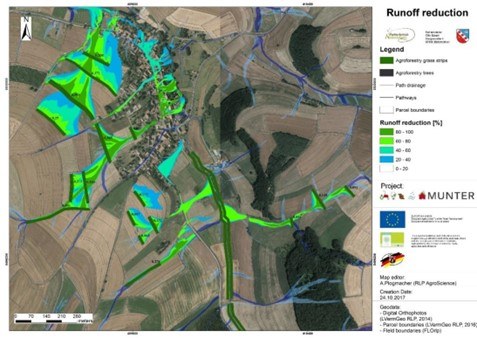
For this replication, for the regions involved and for future activities after the project period, the AFaktive consortium will develop innovative planning methods, including a new GIS model that calculates and illustrates the effects of different agroforestry scenarios on water management and flood levels under extreme weather conditions (see Figure 2).
The project will also contribute to the development of context-specific business models for the involved test locations and replication areas. In doing so, we will look at both value chains for products that come directly from the agroforestry system (wood, fruits, nuts, ...) and the valorisation of indirect, social benefits or ecosystem services (water management, improvement of biodiversity, carbon sequestration). We will take the lessons learned and insights with us, with a view to application in other contexts and areas.
Finally, the project will also pay ample attention to the needs in terms of (adjustments to) policy and regulations, in order to build a stimulating environment for agroforestry systems.
More info?
bert.reubens@ilvo.vlaanderen.be – paul.pardon@ilvo.vlaanderen.be - jolien.bracke@ilvo.vlaanderen.be
Disclaimer
Funded by the European Union. Views and opinions expressed are, however, those of the author(s) only and do not necessarily reflect those of the European Union. Neither the European Union nor the granting authority can be held responsible for them.

This project is financed by the LIFE Sub-programme Climate Action (LIFE-2022-SAP-CLIMA). |